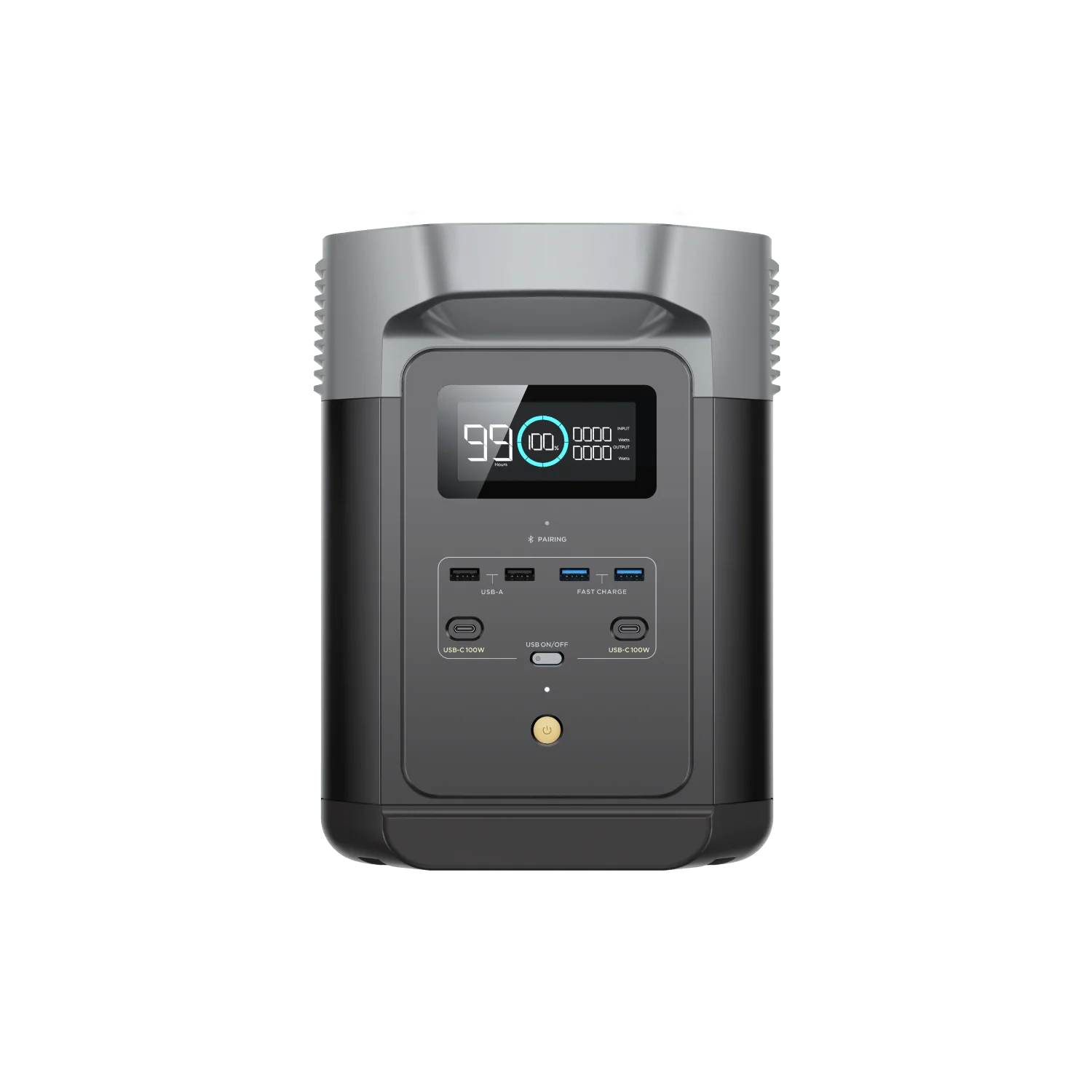
DJI Power 2000 vs EcoFlow DELTA 2
Technical comparison · Home backup
Two LFP home power stations with four mains sockets and a five-year warranty. Solar input separates them: the DJI Power 2000 takes up to 1,800 W of panels, the DELTA 2 500 W (manufacturer-declared values).
| Parameter | ||
|---|---|---|
| Awards | — | |
| In brief | ||
| Nominal capacity | 2.048 kWh | 1.024 kWh |
| Continuous output | 3000 W | 1800 W |
| Peak output | — | 2700 W |
| Cell chemistry | LFP (lithium iron phosphate) | LFP (lithium iron phosphate) |
| Cost per kWh | 781.25 €/kWh | 584.96 €/kWh |
| List price | 1600 € | 599 € |
| Weight | 22 kg | 12 kg |
| Dimensions (W×D×H) | 44.8 × 22.5 × 32.4 cm | — |
| Outlets | ||
| AC outlets | Yes (×4) | Yes (×4) |
| How long it lasts | ||
| Battery life cycles | 1825 cicli | 1825 cicli |
| The limit that runs out first | anni di garanzia | anni di garanzia |
| Rated cycles | 4000 cicli | 3000 cicli |
| Capacity at end of cycle life | 80 % | 80 % |
| Warranty | 5 anni | 5 anni |
| The numbers | ||
| Cost of stored energy | 0.428 €/kWh | 0.321 €/kWh |
| Energy density | 93.1 Wh/kg | 85.3 Wh/kg |
| Power-to-capacity ratio | 1.46 C | 1.76 C |
| Identity | ||
| Use tier | F2 — Room-sized (1–3 kWh) | F2 — Room-sized (1–3 kWh) |
| Price | ||
| Price | 1099 € | — |
| Universal specs | ||
| Voltage | 220 V | 220 V |
| Category specs | ||
| Expandable | Yes | Yes |
| Maximum expanded capacity | 22.528 kWh | — |
| Fastest USB-C | 140 W | 100 W |
| Maximum charge power | 2.2 kW | 1.2 kW |
| 0–80% charge time | 45 min | — |
| Maximum solar input | 1800 W | 500 W |
| Backup power | UPS | EPS (brief interruption) |
| Switchover time | 10 ms | 30 ms |
| Mounting | Portable | Portable |
| Minimum temperature | -10 °C | -10 °C |
| Maximum temperature | 45 °C | 45 °C |
| Noise level | 29 dB | — |

JouleSpecs Awards
Most capable Room-sized (1–3 kWh)
Highest technical score among the 21 sheets in the Home backup category (room-sized tier): 93/100.
How we assign awards →No awards in this tier.
The differences that matter
- Maximum solar input, up to 1,800 W vs 500 W → the DJI can take a large array of panels; the DELTA 2 uses no more than 500 W of them.
- Capacity and continuous output, 2,048 Wh and 3,000 W vs 1,024 Wh and 1,800 W → twice the energy, and a ceiling of 3,000 W where the DELTA 2 stops at 1,800 W.
- Charging from the mains, 2.2 vs 1.2 kW → the DJI refills faster; the maker declares 0 to 80% in 45 minutes.
- Weight, 22 vs 12 kg → the DELTA 2 moves from room to room far more easily; the DJI is placed once and stays there.
Which one to choose
Choose DJI Power 2000 if…
the station stays at home as a fixed base charged from an array of panels, and you want to be able to grow it: the maker declares expansion up to 22.5 kWh. On a power cut it switches over in 10 ms (UPS), which matters for appliances that cannot tolerate a gap, and it declares 29 dB while running. The price is moving it: at that weight it is not a machine built for stairs.
Choose EcoFlow DELTA 2 if…
you move it often, between rooms or out to the car, and a smaller store is enough. You accept a short pause when it moves to battery in a power cut (EPS, 30 ms) and less capacity and output; the declared peak reaches 2,700 W.
Where to buy
Paid link: the price for you does not change.
As an Amazon Associate I earn from qualifying purchases.
The purchase links are the same as on the two product pages and don't influence the verdict. The product pages have the complete data.