BLUETTI Premium 30 V2 vs Jackery Explorer 300 Plus
Technical comparison · Ultraportable
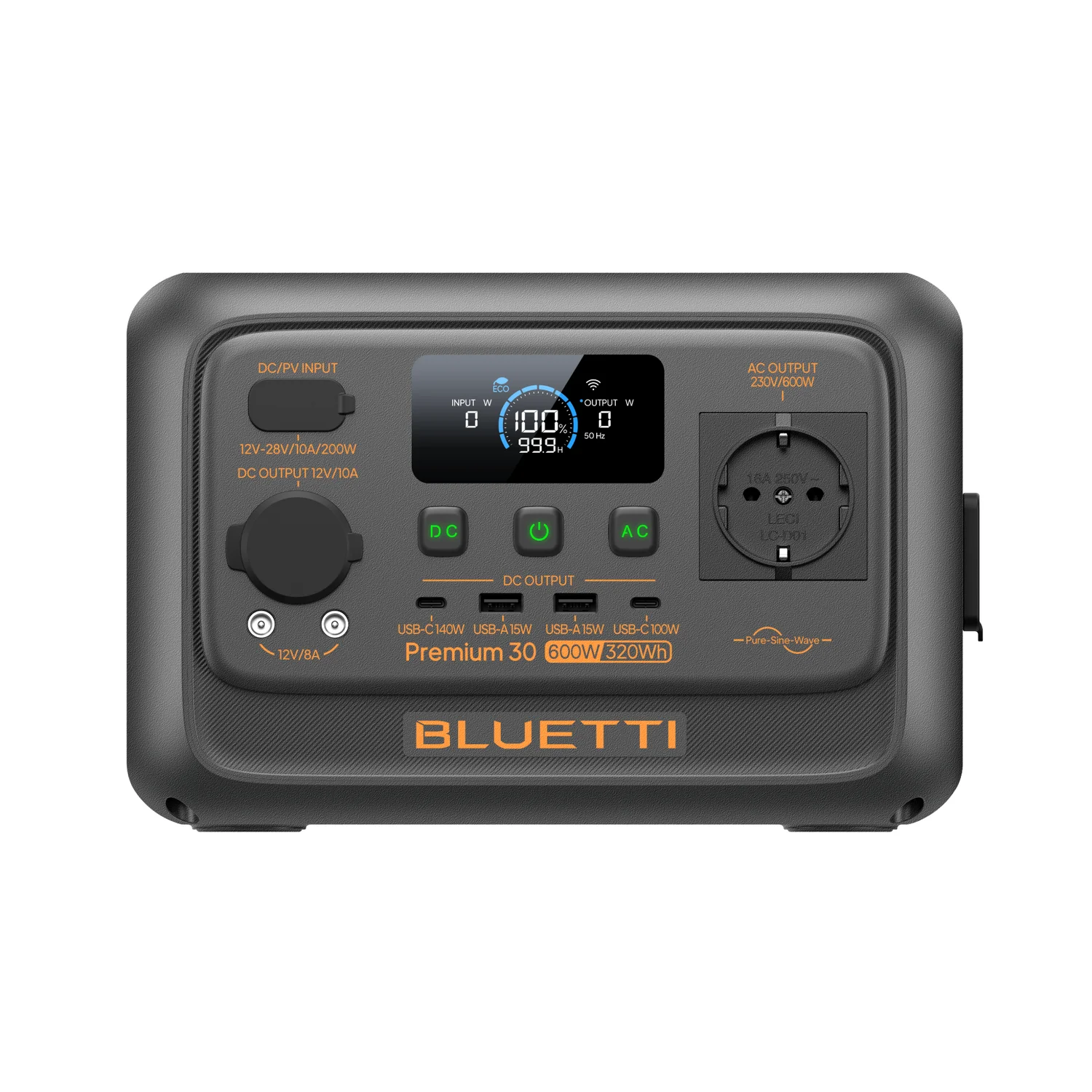
Two plug-in power stations with LFP cells and similar capacity. What decides it is continuous output, 600 W against 300 W: how much you can connect at the same time.
| Parameter | ||
|---|---|---|
| In brief | ||
| Nominal capacity | 0.32 kWh | 0.288 kWh |
| Continuous output | 600 W | 300 W |
| Peak output | 1500 W | 600 W |
| Cell chemistry | LFP (lithium iron phosphate) | LFP (lithium iron phosphate) |
| Cost per kWh | 1090.62 €/kWh | 968.75 €/kWh |
| List price | 349 € | 279 € |
| Weight | 4.3 kg | 3.75 kg |
| Dimensions (W×D×H) | 25 × 17.8 × 16.75 cm | 23 × 15.5 × 16.7 cm |
| Outlets | ||
| AC outlets | Yes | Yes |
| USB-A ports | Yes (×2) | — |
| 12 V outputs | Yes (×2) | — |
| How long it lasts | ||
| Battery life cycles | 1825 cicli | 1095 cicli |
| The limit that runs out first | anni di garanzia | anni di garanzia |
| Rated cycles | 3000 cicli | 3000 cicli |
| Capacity at end of cycle life | 80 % | 80 % |
| Warranty | 5 anni | 3 anni |
| The numbers | ||
| Cost of stored energy | 0.598 €/kWh | 0.885 €/kWh |
| Energy density | 74.4 Wh/kg | 76.8 Wh/kg |
| Power-to-capacity ratio | 1.88 C | 1.04 C |
| Identity | ||
| Use tier | F1 — Outlet-sized (up to 1 kWh) | F1 — Outlet-sized (up to 1 kWh) |
| Price | ||
| Price | ~200–450 € | 279 € |
| Category specs | ||
| Depth of discharge | 95 % | — |
| Expandable | — | No |
| Fastest USB-C | 140 W | 100 W |
| Maximum charge power | 0.38 kW | — |
| 0–80% charge time | 45 min | — |
| Maximum solar input | 200 W | 100 W |
| Backup power | UPS | EPS (brief interruption) |
| Switchover time | 10 ms | 20 ms |
| Standby consumption | 4.5 W | — |
| Ingress protection | IP20 | — |
| Mounting | Portable | Portable |
| Minimum temperature | -20 °C | -10 °C |
| Maximum temperature | 40 °C | 45 °C |
| Noise level | — | 45 dB |
| App required for setup | — | No |
| Declared standards | — | CE, UN 38.3 |

The differences that matter
- Continuous output, 600 W vs 300 W → with the Jackery you plug in one load at a time; the BLUETTI handles several devices together.
- Solar input, 200 W vs 100 W → the panel the battery can use is twice as big; beyond 100 W the Jackery takes in no more.
- Backup power, UPS in 10 ms vs EPS in 20 ms → when the grid drops, the BLUETTI is declared to switch over with no gap; the Jackery leaves a brief interruption on whatever is plugged in.
- Warranty, 5 years vs 3 → on both, the warranty runs out before the 3,000 stated cycles do: the useful life on paper is 5 years or 3.
Figures are as declared by the manufacturer.
Which one to choose
Choose BLUETTI Premium 30 V2 if…
you work in a cold garage or shed, where it is declared to run down to −20 °C, and want a USB-C port of up to 140 W for the laptop. The trade-off: 4.3 kg instead of 3.75 kg, and a 40 °C ceiling instead of 45 °C.
Choose Jackery Explorer 300 Plus if…
you want something smaller and lighter: 3.75 kg and 23 × 15.5 × 16.7 cm. It switches on without the app and is declared to cope up to 45 °C; in exchange you start from 0.288 kWh instead of 0.32, it is not declared below −10 °C and the USB-C port stops at 100 W.
Where to buy
Paid link: the price for you does not change.
As an Amazon Associate I earn from qualifying purchases.
The purchase links are the same as on the two product pages and don't influence the verdict. The product pages have the complete data.