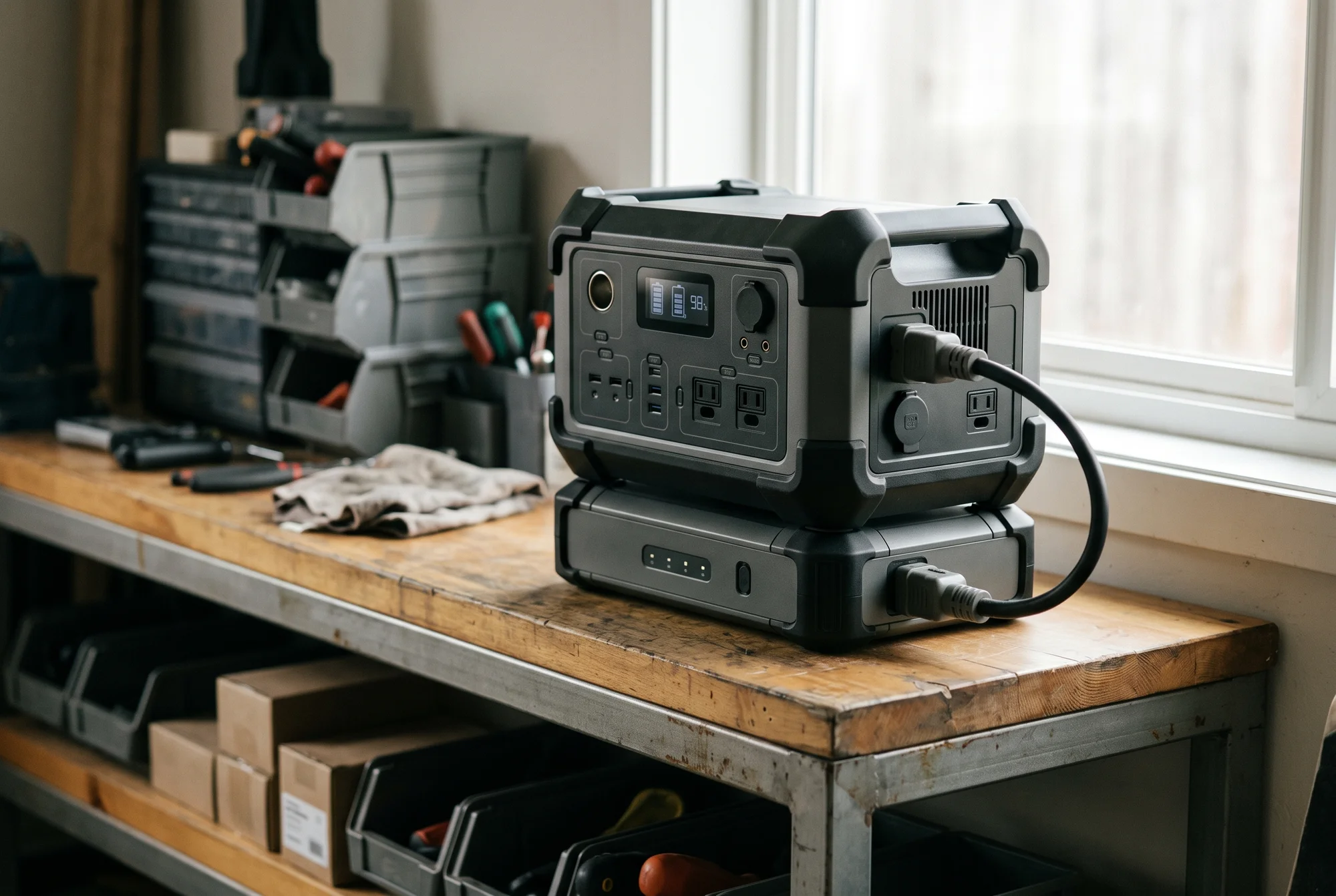
Power station as a backup supply: what to check
To keep a router, PC and fridge running through a blackout, only a few fields on the product page matter. Here is which ones, and which numbers you can ignore.
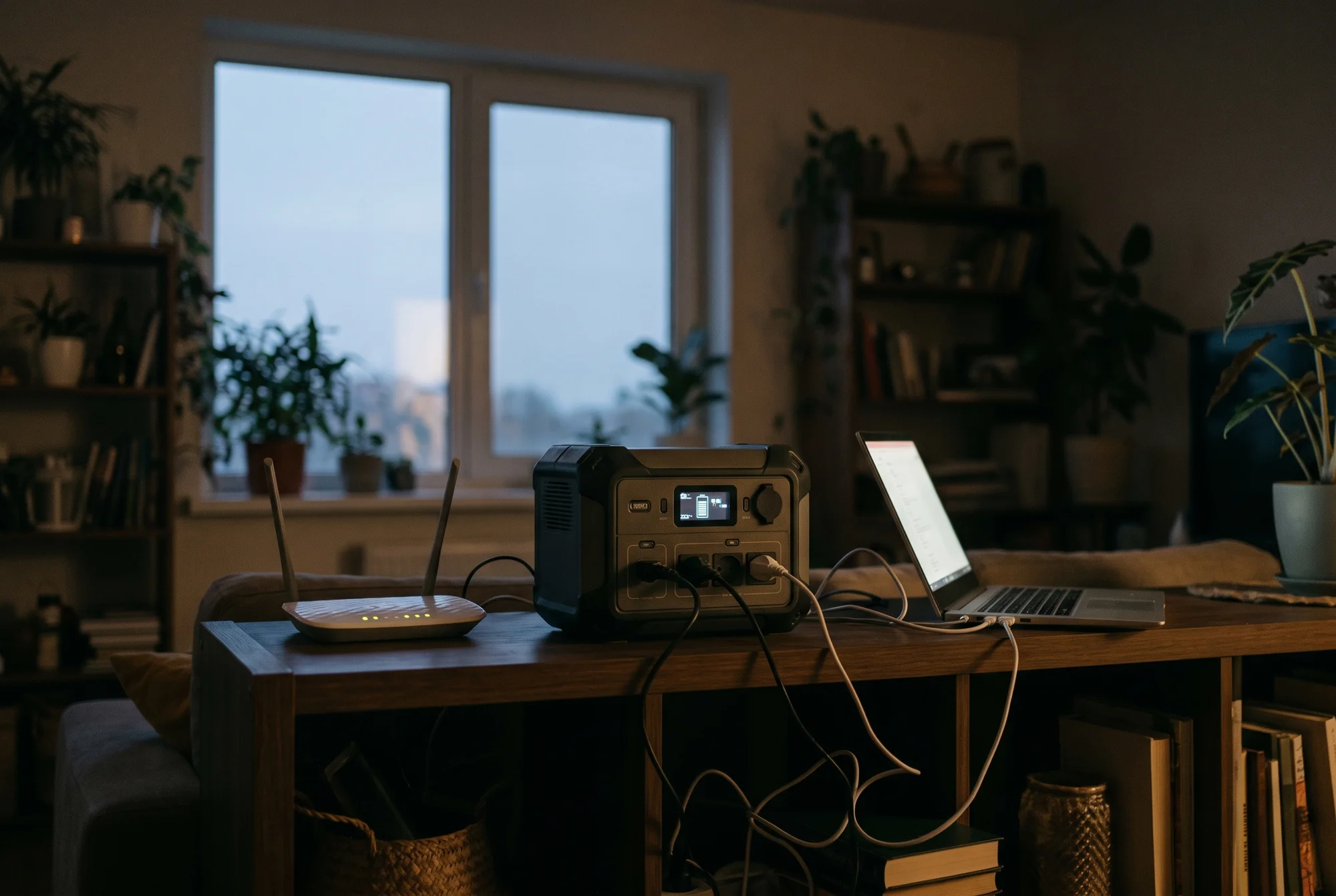
A home power station isn't born as an uninterruptible power supply, but it can do the same job: when the grid drops, it takes the place of the outlet and keeps the router, computer and fridge running. The catch is that product pages list dozens of numbers and only some of them matter for this use. In the «Home, with continuity» category we have 25 product pages; here is how to read them.
The field that decides: switchover time
If you need to protect a computer or a NAS, the first thing to look at is how fast the machine moves to battery. The difference shows in the pages: the BLUETTI Elite 200 V2 switches in 15 milliseconds, the EcoFlow DELTA 3 Plus in ten, the Jackery Explorer 2000 v2 in twenty. For a router or a fridge all of these are more than enough. For a desktop PC or a server it's another matter: the Jackery's page says to avoid it with servers and workstations because it isn't professional-grade power, and the Elite 200 V2's page says it doesn't replace a professional UPS for equipment that can't tolerate interruptions.
A detail few people check: orderly shutdown. The DELTA 3 Plus connects by USB-C cable to a computer or a NAS, which can shut themselves down if the blackout outlasts the runtime. For anyone with data to protect, that matters more than a few milliseconds.
Continuous output versus peak
The big number on the manufacturer's page is often the peak. What counts for continuity is the continuous power: the sum of what you want to keep on at the same time, with some margin. The peak serves another purpose, starting motors: a fridge, a pump or a washing machine draws far more for an instant. The Jackery Explorer 2000 v2 page says the peak comfortably exceeds the continuous rating, enough to start a washing machine or a pump without the output tripping. So: add up the loads that stay on together and compare them with the continuous rating; use the peak only to check motor starts.
Capacity: how long a blackout you can ride out
Capacity doesn't tell you how much load you can carry, but for how long. Watt-hours are divided by the watts drawn, and the real result is always a bit below the theoretical one because of inverter losses. For a router a few watts are enough and the runtime is counted in days; for the fridge, the maths is in our guide on how many hours a fridge lasts. The BLUETTI Elite 200 V2 is a two-kilowatt-hour machine built to keep a fridge, a router and a few lights going for hours, and its page says so.
Expandable or fixed
This is one of the fields that really changes the choice. The DELTA 3 Plus has a port for extra batteries and grows if the starting runtime isn't enough. The Elite 200 V2 and the Explorer 2000 v2 have fixed capacity: what you buy is what you get. If you don't know how long your blackouts last, the expandable route is safer; if your grid almost always holds and you only need a cushion, the fixed one costs less and weighs less.
Charging and grid pass-through
For continuity it matters that the machine can recharge while it powers loads and that it comes back to full quickly. The Elite 200 V2 charges and powers at the same time and reaches 80% in an hour; the Explorer 2000 v2 does it in under an hour: useful if the blackout finds it already empty. Mind the ports: the Elite 200 V2 has a single DC port, so grid plus sun or grid plus car, never all three together.
What is just marketing
- The peak, on its own. If you don't know the continuous rating, you don't know what you can plug in.
- The number of USB ports. Useful camping, irrelevant for keeping a router on.
- Cycle life on the box. For a reserve that rarely discharges it decides nothing: the warranty matters more.
- The app's smart modes. Handy for scheduling when it steps in, but they don't fix the wrong machine.
What it costs
Among machines with a list price in our catalogue the range is wide: the BLUETTI Elite 100 V2 is 499 euro, the Jackery Explorer 2000 v2 799, the Elite 200 V2 899, the BLUETTI Elite 300 1,399. For a router and a fridge you don't need the top tier: you need the continuous rating to cover the loads and the capacity to cover the hours. If you're choosing between two models in the same bracket, look at the direct comparison, for example BLUETTI AC180P vs Jackery Explorer 2000 v2.
How to choose
If you're keeping a router and a few lights on, start from a small machine and look only at capacity. If there's a fridge, check the continuous rating and the motor start. If there's a computer or a NAS, pick a model with a stated switchover time and orderly shutdown, and remember that equipment that can't tolerate interruptions needs a real UPS. If you don't know how long your blackouts last, choose an expandable machine.