How many hours will the fridge last, and the other sums you do by hand
A fridge doesn't draw the watts on its nameplate, and multiplying watts by hours is the mistake that's out by a factor of three. The two figures to keep separate, and how to work out runtime with the measurements that actually exist.
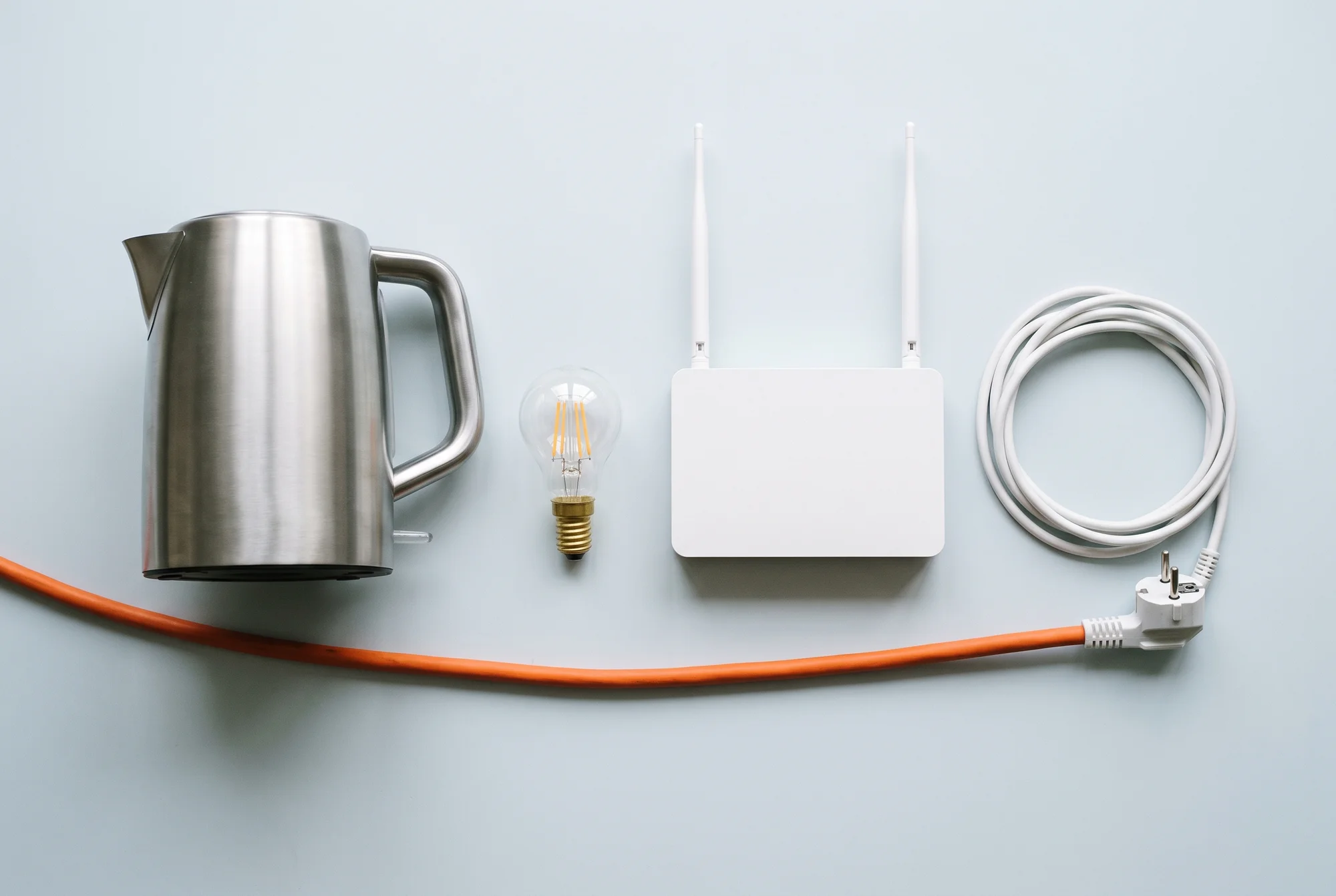
The question always comes in the same shape: "can I keep the fridge running?" The answer that goes around is a multiplication — the appliance's watts times the hours you need — and for a fridge it's wrong by a factor of two or three.
The reason is that a fridge doesn't draw the watts on its nameplate. The compressor starts, cools, stops, and stays off for most of the time.
Two numbers, and you can't use just one
Every appliance has two quantities that answer two different questions:
| What it decides | Unit | Where it's written | |
|---|---|---|---|
| Power | whether the inverter can cope, right now, with everything switched on together | W | on the appliance's nameplate |
| Energy | how long the battery lasts | Wh | on the European energy label, where it exists |
They're independent. A kettle draws twenty times what a fridge-freezer does and over a day consumes less than half as much. A router draws eight watts and, staying on around the clock, consumes more than a microwave.
There's an awkward asymmetry in the data: the European label gives energy well and almost never power. No regulation requires printing the watts drawn by motor-driven appliances, and catalogues give nameplate power, which is a different thing. It's bad news dressed up as good news: the question "how long does it last" is answered with energy, which is the figure that's covered.
How much cold really consumes
These are measurements, not nameplates: they come from the British Household Electricity Survey, which instrumented 250 households appliance by appliance with two- or ten-minute meters.
| Energy in a day | Power while running | |
|---|---|---|
| Fridge-freezer | 950–1,150 Wh | not published by anyone |
| Freezer | 700–800 Wh | measured peaks of 45–50 W |
| Fridge without freezer | 350–450 Wh | not published by anyone |
The same study also gives the raw range for all the cold appliances in a home put together: 820 to 2,300 Wh a day. It's the figure worth keeping in mind when wondering whether you can ride out a power cut.
The right-hand column is missing the most requested row, and it's a genuine gap: the power of a fridge with the compressor running isn't on any European label. We don't declare it because we haven't found it, not because we haven't looked. If you need it, it's on the nameplate behind your own.
The sum, in three lines
available energy (Wh) = usable capacity (kWh) × 1,000 × efficiency
hours = available energy / appliance's daily consumption × 24
With a fridge-freezer at 1,050 Wh a day: a battery delivering 1 kWh covers just under a day; one delivering 2 kWh, just under two. If at the same time you're also running the router — 150–230 Wh a day, measured by the European Code of Conduct on broadband equipment — the sum drops by about a fifth.
Two warnings about the first line, and they're the same ones every JouleSpecs spec sheet prints next to its figures:
- usable capacity isn't the nameplate one. As of 23 September 2026 it's declared by two products out of 88: on all the others the sum starts from the nominal figure, so it's optimistic;
- efficiency — how much of what you put in you get back — is declared by two products out of 88. Where it's missing, the sum behaves as if nothing were lost, which also pulls towards optimism.
Between the two, the figure you get is a ceiling, not a forecast.
Inrush current: 5.4 times, for four seconds
An induction motor starting under load draws many times its running current. That's why a power station declares a peak power on top of its continuous one, and why a fridge can fail to start when plugged into an inverter that, on paper, has enough watts.
The figure isn't a general rule: it comes from the datasheet of a 220–240 V fridge compressor, which declares 12.25 A locked-rotor current against 2.27 A rated — 5.4 times, for a maximum of four seconds.
Have inrush: fridge, freezer, compressor cool box, air conditioner, pumps, compressors, power tools, vacuum cleaners. Don't have it: kettle, induction hob, heater, lights, laptop, phone, router, television. A 2,200 W kettle asks for 2,200 W from the first instant and not a watt more.
The kettle is the entrance exam
If you only run one test before buying, do it with the kettle. The energy of a boil is small — 170 watt-hours at full load, measured — but the power it draws while doing it is large, and in Europe it's higher than elsewhere because the socket allows it: a continental kettle sits around 2,000–2,200 W.
It's the load that stops power stations chosen by looking at an American site, where the same appliance category is sold at 120 V with lower nameplate power. The American appliance list doesn't translate: the socket changes, the watts change.
From the same study, a note worth more than many batteries: not overfilling the kettle beyond what's needed is worth 39 kWh a year, or 229 boils.
What nobody declares
Some appliances everyone wants in the sum have no public figure in Europe, and we'd rather leave them blank than fill them in with battery manufacturers' blogs:
- the microwave oven has no energy label: the regulation governing hobs explicitly excludes it. It isn't a gap of ours, it's a gap in the rule;
- the laptop, the fan, the compressor cool box, the CPAP machine: only blog figures, no technical source;
- the induction hob has a legal ceiling — under 195 Wh per kilogram of load — but a ceiling tells you a compliant appliance stays under it, not what yours actually consumes.
For all of these there's one route: read the watts off your own nameplate and put them in the sum. The number is yours, the arithmetic is ours.
Two easy cases, on the other hand. LED lamps carry the kWh per thousand hours on their label, and that same figure multiplied by a thousand is the watts: one number that gives you two. And the single-duct portable air conditioner is the only air conditioner for which the European label gives hourly energy directly — exactly the figure a battery needs.
When the answer isn't a bigger battery
Two cases where the sum says buy less, not more.
The filter coffee machine left on its hotplate. Up to 100 W for more than ten hours a day is a thousand watt-hours: more than the rest of the day put together. Since 2013, automatic shutoff within thirty minutes has been mandatory as a factory setting in Europe — if someone's turned it off, the answer is to turn it back on.
The freezer during a power cut. A full freezer holds its cold for hours even switched off. Before connecting it to a battery, often the right move is simply not to open it.
Do it with your own appliances
The How much energy do you need tool does this sum with the list you choose, keeps energy and power separate, adds the inrush of the largest motor, and tells you which appliances it had to leave out because we don't know their figures. From there you reach the catalogue already filtered on the capacity and power you need.
If instead the question is cost, not runtime, the sum is a different one: how much does every kWh passing through the battery cost.
Sources
- P. Dunbabin, J. Palmer, N. Terry, Electricity use by domestic appliances in English households, eceee 2015 Summer Study — Household Electricity Survey, 250 instrumented households; figures read from graphs, hence approximate — Source 1
- J. Palmer, N. Terry, Powering the Nation 2, DECC/Defra, 2014 — 170 Wh per boil at full load — Source 2
- M. Acton et al., EU Code of Conduct on Energy Consumption of Broadband Equipment, Version 6, JRC, 2017 — power measured at 230 V, per interface — Source 3
- Secop, Technical Data Compressor NLE10CN, 220–240 V / 50 Hz, July 2024 — 12.25 A locked-rotor current for 4 s against 2.27 A rated — Source 4
- Regulation (EU) No 66/2014, hobs — ceiling of 195 Wh/kg and explicit exclusion of microwave appliances — Source 5
- Commission Delegated Regulation (EU) 2019/2015, light sources — consumption in kWh per 1,000 hours — Source 6
- Commission Delegated Regulation (EU) No 626/2011, air conditioners — hourly energy in kWh/h for single-duct units — Source 7
- N. Gross, E. Bush (Topten), Efficient Coffee Machines, EEDAL 2022 — keep-warm up to 100 W for over ten hours, and automatic shutoff at 30 minutes mandated by Regulation (EU) 801/2013 — Source 8
Three examples from the catalogue

Why it's here Backup power: UPS · manufacturer's source
Check the price on Amazon
Why it's here Switchover time: 10 ms · manufacturer's source
Check the price on Amazon
Why it's here Continuous output: 2400 W · manufacturer's source
Check the price on AmazonPaid link: the price for you does not change.
As an Amazon Associate I earn from qualifying purchases.