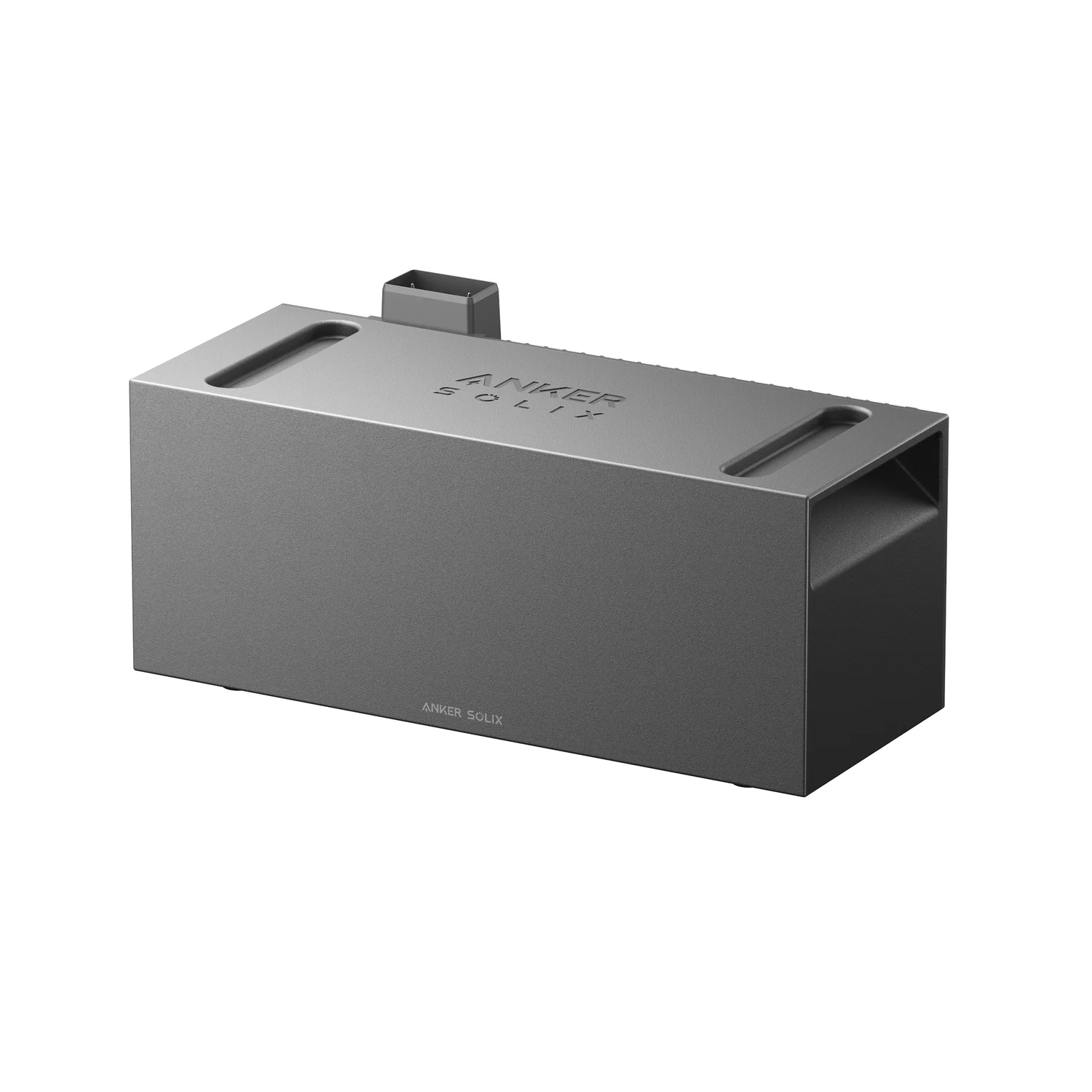
Photo from the manufacturer
Zendure Zendure AB3000X
JouleSpecs does not sell and does not show shop prices: check the price where you buy.
Where to buy
Check the price on AmazonPaid link: the price for you does not change.
As an Amazon Associate I earn from qualifying purchases.
Zendure AB3000X is an expansion battery for balcony storage, built to add capacity to an already installed SolarFlow 2400 AC system: on its own it isn't a standalone product. It mounts on the wall with the included brackets, so it can't tip over. It uses lithium iron phosphate cells and accepts a lot of charging and discharging power, so the pack fills up faster even when the system demands a lot. If it detects a short circuit or abnormal heating, an aerosol system triggers on its own and smothers the start of a fire without water or chemical powder.
It pairs with other identical batteries up to the full capacity the SolarFlow 2400 AC system can manage, adding them when needed instead of buying everything at once. It heats itself when the temperature drops, so it keeps charging even on a cold day.
It's built for anyone who has already chosen SolarFlow 2400 AC and wants to grow their balcony's energy reserve over time, not for anyone looking for a portable battery to use on its own.
JouleSpecs Awards
Best value Room-sized (1–3 kWh) · Expansion batteries
Best balance of technical score and price among the 3 sheets in the Expansion batteries category (room-sized tier): list price €599, technical score 67/100.
How we assign awards →Lowest price range Room-sized (1–3 kWh) · Expansion batteries
The lowest list price among the sheets in the Expansion batteries category (room-sized tier): €599. The next one has a list price of €699. List prices as published by the manufacturers.
How we assign awards →Technical specifications
midpoint of the estimated range — on nominal capacity
| Parameter | Value | Source |
|---|---|---|
| Weight | 26.1 kg (57.5 lb) | manufacturer website |
| Compatible models | SolarFlow 2400 AC | Declared by the brand |
| Nominal capacity | 2.88 kWh | Declared by the brand |
| Cell chemistry | LFP (lithium iron phosphate) | Declared by the brand |
| Expandable | Yes | Declared by the brand |
| Maximum expanded capacity | 17.28 kWh | Declared by the brand |
| Battery voltage | 48 V | Declared by the brand |
| Maximum charge power | 2.88 kW | Declared by the brand |
| Rated cycles | 6000 cicli | Declared by the brand |
| Warranty | 10 anni | Declared by the brand |
| Ingress protection | IP65 | Declared by the brand |
| Mounting | Wall mounted | Declared by the brand |
| Minimum temperature | -20 °C | Declared by the brand |
| Maximum temperature | 60 °C | Declared by the brand |
| Cell heating | Yes | Declared by the brand |
| Declared standards | CE | Declared by the brand |
| Usable capacity | — | Not declared |
| Depth of discharge | — | Not declared |
| Cell supplier | — | Not declared |
| Feed-in limit | — | Not declared |
| Inverter included | — | Not declared |
| Maximum solar input | — | Not declared |
| MPPT trackers | — | Not declared |
| Grid charging | — | Not declared |
| Dynamic tariffs | — | Not declared |
| Backup power | — | Not declared |
| Backup output | — | Not declared |
| Switchover time | — | Not declared |
| Capacity at end of cycle life | — | Not declared |
| Guaranteed throughput | — | Not declared |
| Guaranteed remaining capacity | — | Not declared |
| Round-trip efficiency | — | Not declared |
| Standby consumption | — | Not declared |
| Noise level | — | Not declared |
| Works without internet | — | Not declared |
| Local control | — | Not declared |
| Open protocols | — | Not declared |
| Home Assistant integration | — | Not declared |
| Where the data is hosted | — | Not declared |
| Remote updates | — | Not declared |
| App required for setup | — | Not declared |
| Battery passport | — | Not declared |
| Carbon footprint | — | Not declared |
| Recycled content | — | Not declared |
Which documents this page rests on
The rest of the data comes from one page on the manufacturer's site, cited row by row in the table above.
A manual or a datasheet counts as a source even when the original file is hosted elsewhere: what matters is the document, not the server. Where that happens, it is stated above.
What it really costs
How we worked it out
- price
- 725
- nominal capacity
- 2.880
- the manufacturer does not state the guaranteed total energy throughput, which for heavy users is often the limit that runs out first
How we worked it out
- stated cycles
- 6000
- warranty years
- 3650
- the manufacturer does not state the guaranteed total energy throughput, which for heavy users is often the limit that runs out first
- on nominal capacity: the manufacturer does not state the usable figure, so the real cost is higher
- without conversion losses, which the manufacturer does not state: the real cost is higher
How we worked it out
- price
- 725
- nominal capacity
- 2.880
- battery life cycles
- 3650
- round-trip efficiency
- 100
- energy delivered over the whole life
- 10512
- on nominal capacity: the manufacturer does not state the usable figure, so the true number is lower
How we worked it out
- nominal capacity
- 2.880
- weight
- 26.100
These numbers are calculated, not stated: they have no source to cite, they have a formula you can redo. The price used is the manufacturer's list price, which is stable and the same in every country — not a shop's price on the day.
Pros and cons
In favour
- It accepts a lot of charging and discharging power, so the pack fills up faster even when the system demands a lot.
- It pairs with other identical batteries up to the full capacity the system can manage, adding them when needed instead of buying everything at once.
- It heats itself when it's cold, so it keeps charging even below zero.
- If it detects a short circuit or abnormal heating, an aerosol system triggers on its own and smothers the start of a fire without water or chemical powder. source
Worth knowing
- It only connects to the SolarFlow 2400 AC system: it isn't compatible with SolarFlow 2400 Pro or AC+.
- It's over 26 kg: it doesn't move around easily on its own, better to plan for two people to carry it. source
- Above 50 degrees it stops accepting charge: on a very hot day or near a heat source, solar charging can stop earlier than expected. source
Similar products worth weighing up
Other products Zendure
Alternatives in the catalogue
Chosen by the declared use tier and footprint, not by price: we don't publish prices.
Updates to this sheet and Manufacturer Notes
-
Price updated