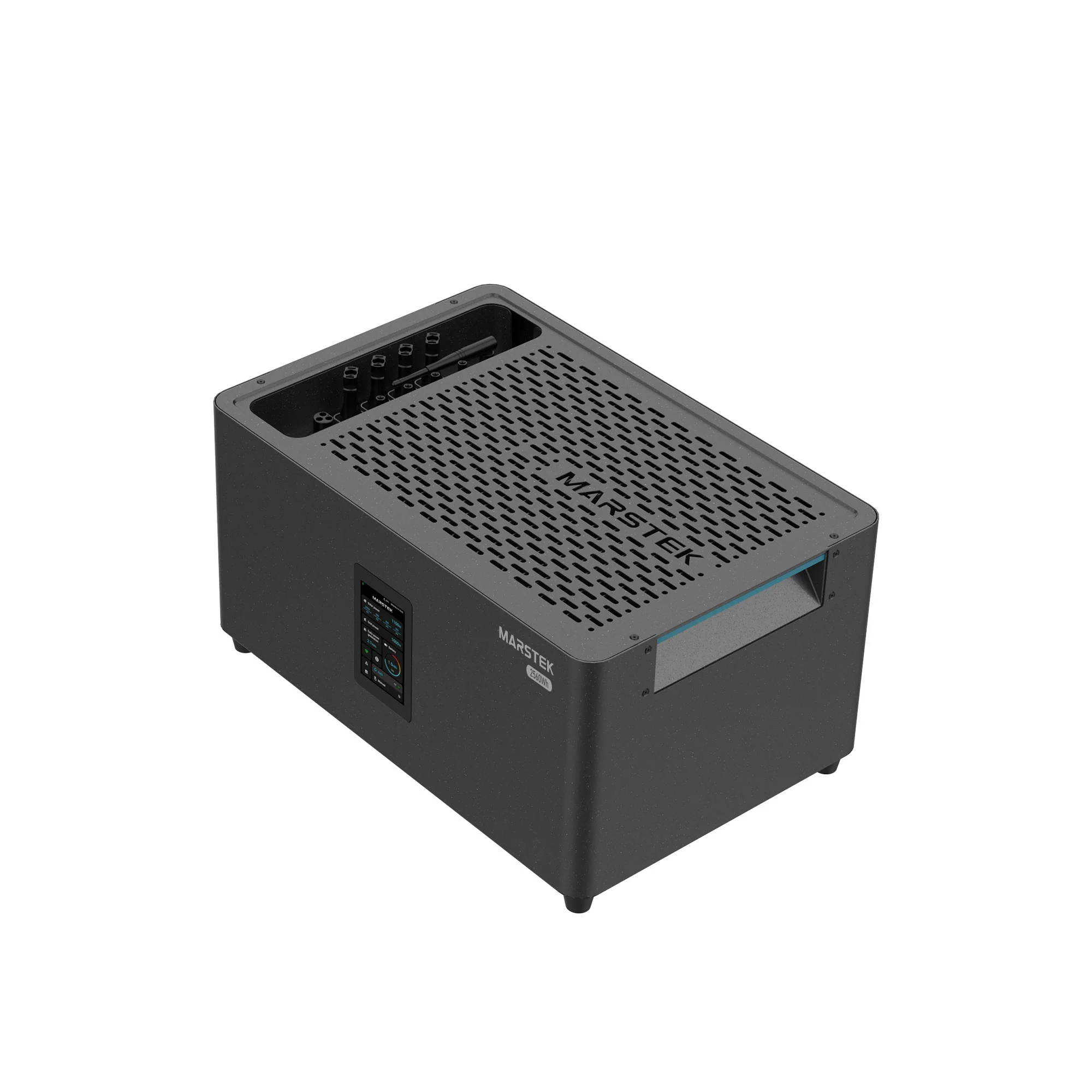
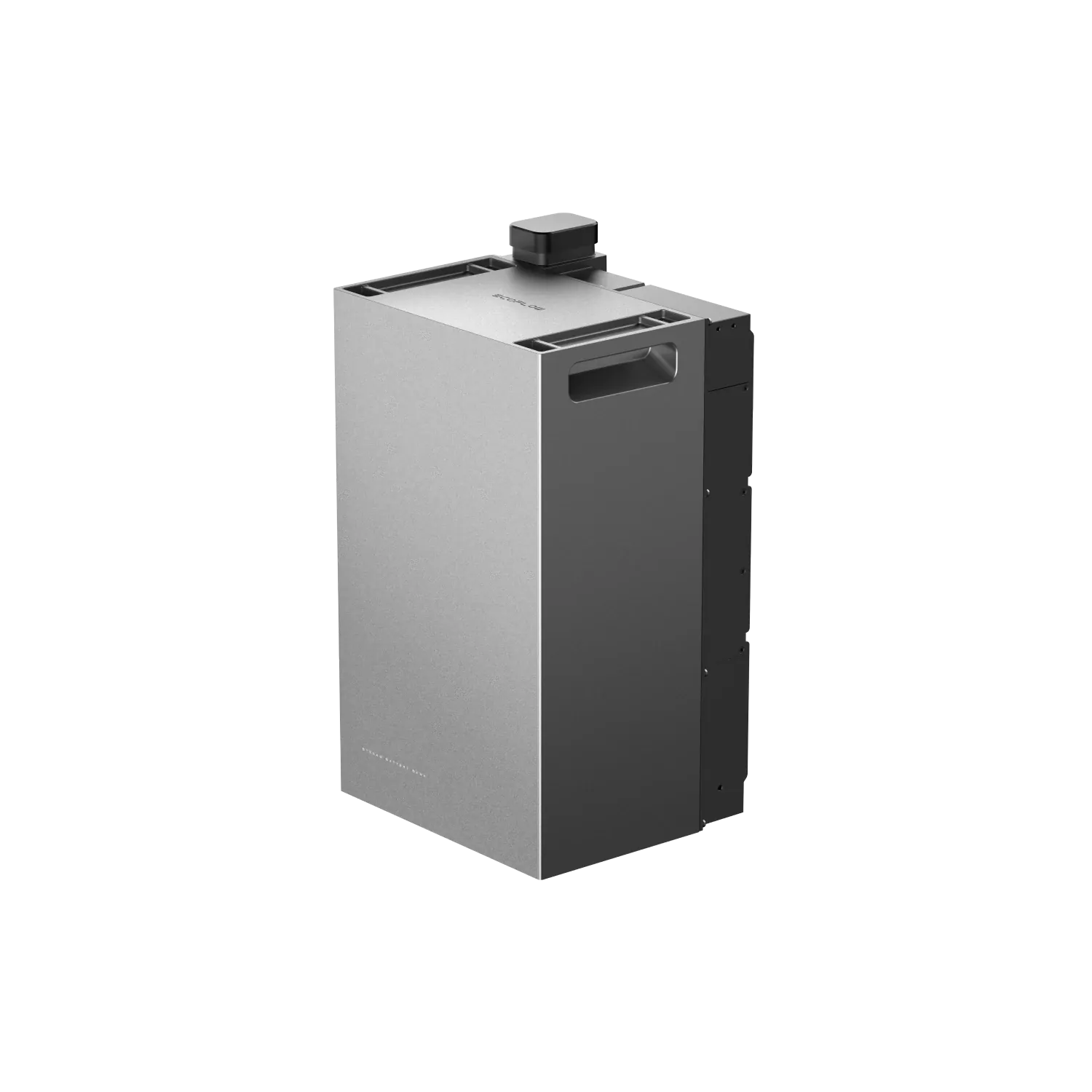
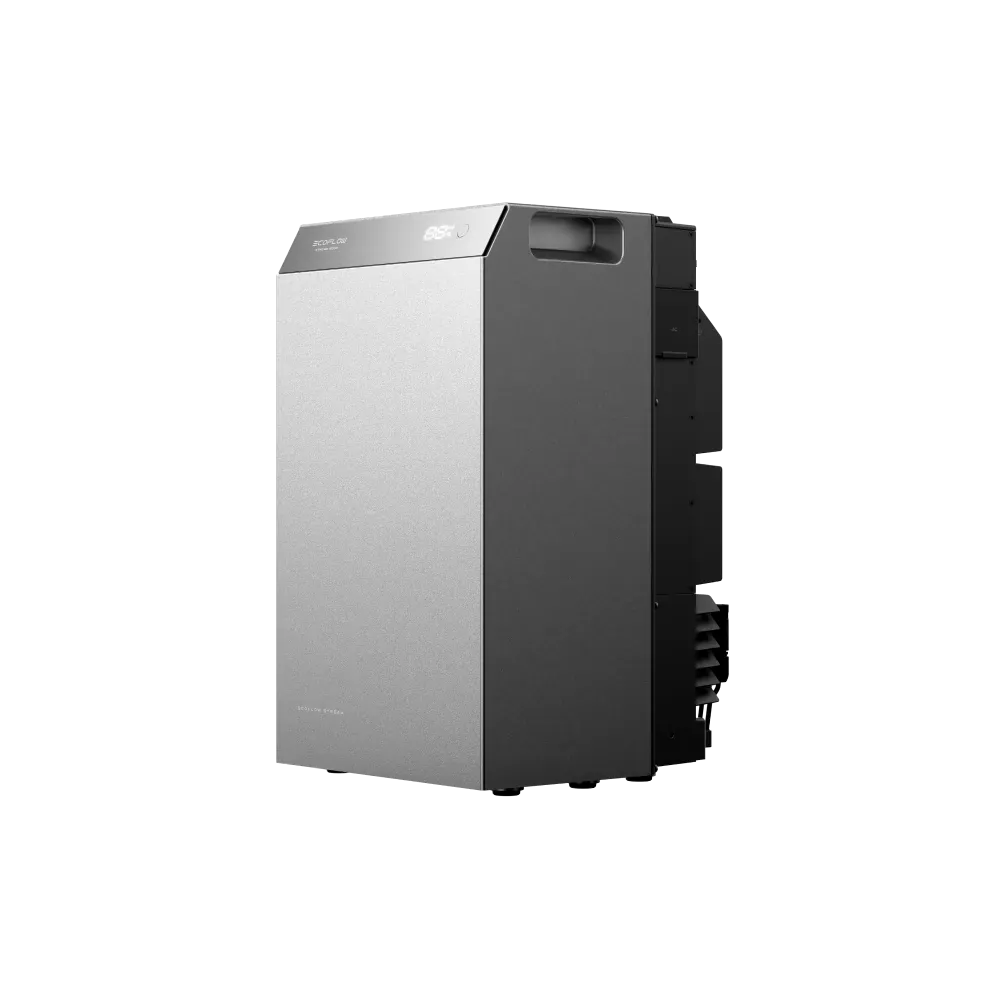
Photo from the manufacturer
EcoFlow EcoFlow STREAM 5000
JouleSpecs does not sell and does not show shop prices: check the price where you buy.
The EcoFlow STREAM 5000 is balcony storage in a single body: the battery and the inverter sit in the same enclosure, and panels connect directly to it, on four independent inputs. That means two panels facing different directions, or one in shade halfway through the day, each work on their own without dragging the other down. When the base battery isn't enough anymore, dedicated expansion batteries stack underneath, up to a three-unit system.
It feeds into the home at a nominal power that is limited depending on the country of installation, and on the body it has an outlet that keeps supplying power when the grid goes down: enough for fridge, router and a few lights. In the app you set charge and discharge schedules based on time, sun, tariff and appliances, so discharging can be placed in the hours when power costs more.
It's for anyone with their own panels, on the balcony or the roof, who wants battery and inverter together, with the option to grow later without changing anything. Anyone who already has a micro-inverter and just wants to add storage should instead look at a model that pairs on alternating current.
Technical specifications
official manufacturer list price — on nominal capacity
| Parameter | Value | Source |
|---|---|---|
| Weight | 45.4 kg (100.1 lb) | manufacturer website |
| Nominal capacity | 5.024 kWh | Declared by the brand |
| Cell chemistry | LFP (lithium iron phosphate) | Declared by the brand |
| Expandable | Yes | Declared by the brand |
| Maximum expanded capacity | 15 kWh | Declared by the brand |
| Battery voltage | 16 V | Declared by the brand |
| Feed-in limit | 800 VA | Declared by the brand |
| Inverter included | Yes | Declared by the brand |
| Maximum solar input | 5000 W | Declared by the brand |
| MPPT trackers | 4 | Declared by the brand |
| Grid charging | Yes | Declared by the brand |
| Dynamic tariffs | Built in | Declared by the brand |
| Backup power | EPS (brief interruption) | Declared by the brand |
| Backup output | 2500 W | Declared by the brand |
| Rated cycles | 10000 cicli | Declared by the brand |
| Capacity at end of cycle life | 60 % | Declared by the brand |
| Warranty | 10 anni | Declared by the brand |
| Ingress protection | IP65 | Declared by the brand |
| Mounting | Floor standing | Declared by the brand |
| Minimum temperature | -20 °C | Declared by the brand |
| Maximum temperature | 55 °C | Declared by the brand |
| Declared standards | CE, VDE-AR-N 4105, EN 50549, CEI 0-21, G98 / G99, IEC 62477 | Declared by the brand |
| Official list price | 1899 € | Declared by the brand |
| Usable capacity | — | Not declared |
| Depth of discharge | — | Not declared |
| Cell supplier | — | Not declared |
| Maximum charge power | — | Not declared |
| Switchover time | — | Not declared |
| Guaranteed throughput | — | Not declared |
| Guaranteed remaining capacity | — | Not declared |
| Round-trip efficiency | — | Not declared |
| Standby consumption | — | Not declared |
| Cell heating | — | Not declared |
| Noise level | — | Not declared |
| Works without internet | — | Not declared |
| Local control | — | Not declared |
| Open protocols | — | Not declared |
| Home Assistant integration | — | Not declared |
| Where the data is hosted | — | Not declared |
| Remote updates | — | Not declared |
| App required for setup | — | Not declared |
| Battery passport | — | Not declared |
| Carbon footprint | — | Not declared |
| Recycled content | — | Not declared |
Which documents this page rests on
The rest of the data comes from 2 pages on the manufacturer's site, cited row by row in the table above.
A manual or a datasheet counts as a source even when the original file is hosted elsewhere: what matters is the document, not the server. Where that happens, it is stated above.
What it really costs
How we worked it out
- price
- 1899
- nominal capacity
- 5.024
- the manufacturer does not state the guaranteed total energy throughput, which for heavy users is often the limit that runs out first
How we worked it out
- stated cycles
- 10000
- warranty years
- 3650
- the manufacturer does not state the guaranteed total energy throughput, which for heavy users is often the limit that runs out first
- on nominal capacity: the manufacturer does not state the usable figure, so the real cost is higher
- without conversion losses, which the manufacturer does not state: the real cost is higher
How we worked it out
- price
- 1899
- nominal capacity
- 5.024
- battery life cycles
- 3650
- round-trip efficiency
- 100
- energy delivered over the whole life
- 18338
- on nominal capacity: the manufacturer does not state the usable figure, so the true number is lower
How we worked it out
- nominal capacity
- 5.024
- weight
- 45.400
These numbers are calculated, not stated: they have no source to cite, they have a formula you can redo. The price used is the manufacturer's list price, which is stable and the same in every country — not a shop's price on the day.
Pros and cons
In favour
- Panels facing different directions each work on their own: shade on one doesn't hold back the others.
- When the power goes out, the backup outlet keeps fridge, router and lights running.
- It lets you schedule discharging for the hours when energy costs more, if the tariff changes during the day.
- It grows by stacking expansion batteries, without changing the main unit.
Worth knowing
- The backup outlet gives its full power only with an expansion battery and panels connected: without either one, it gives less.
- Growing takes dedicated expansion batteries, and the system tops out at three units.
- Water resistance only holds with the outlet's cover closed: left open, the unit loses the protection.
Similar products worth weighing up
Other products EcoFlow
Updates to this sheet and Manufacturer Notes
-
Sheet published